
Have we really been listening?
By Dr. Wan Afiqah Anis Wan Ahmad
I spend much of my working life telling students to listen.
Listen to the instructions. Listen for the main idea. Listen properly before you answer. I am an English lecturer, so listening is not only something I want from my students, it is something I grade them on.
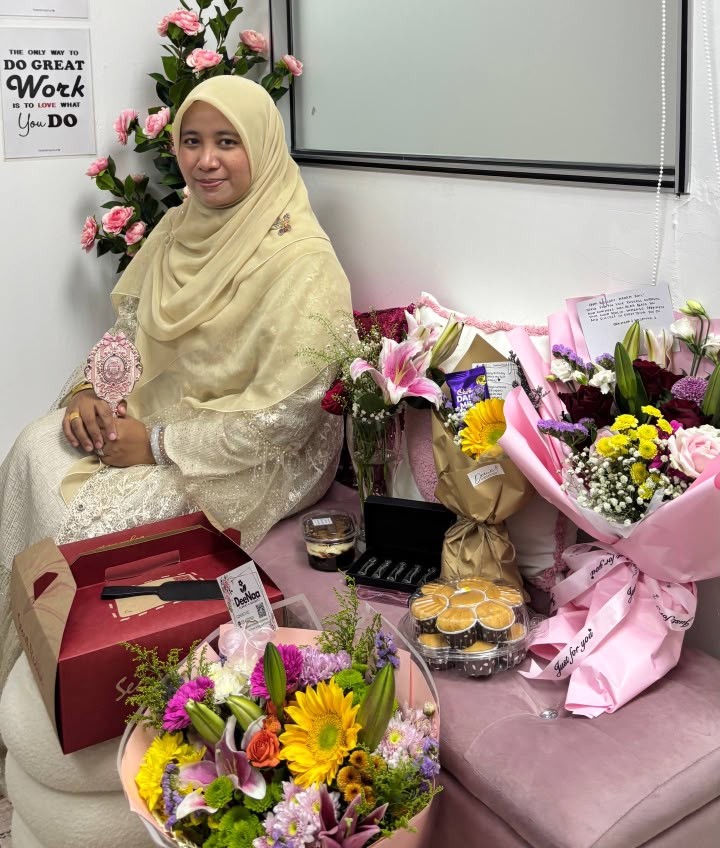
Then my birthday came and my students handed me something I could not grade at all. They sang the moment they saw me. Someone had clearly organised it, because the singing kept happening, class after class, all day. And then the flowers came, bouquets, held out by students who suddenly looked shy after all that noise. Anyone who knows me knows flowers are my weakness. And there I stood: the lecturer who always has something to say, saying nothing at all.
My first thought was not profound. It was affectionate and a little bewildered: Madam marah pun kamu bagi bunga? Even after the scolding? The reminders? The times I made you do it again because I knew you had a better draft in you? We laughed. I said thank you more times than I can count, and none of them felt sufficient. But underneath the laughing and the gratitude, a question settled in and has not left since.
Had I noticed how closely they were listening? In a classroom, we judge attention by what we can see. The student who looks up seems attentive. The one who answers first seems engaged. When a student cannot repeat what I just said, out comes the question every teacher has asked: “Were you listening?” Sometimes I need to ask it. But it only measures one kind of attention, the kind that ends up on a transcript.
Students listen to the subject. They also listen to the person teaching it. Somewhere among the lessons and the deadlines and the small talk before class starts, mine had picked up something about me. A passing remark, maybe. Something one of them overheard and repeated to the others. However it travelled, they had worked out that flowers would make their lecturer happy. I still do not know when they learned it and honestly, that is the part that gets me. Something I said without thinking had been caught, kept and acted on. That is empathy doing its quiet work, not the version we define in a comprehension passage, but the version that pays attention to a person and then bothers to remember.
We usually treat listening as accuracy. Can you identify the main idea? Can you recall the details? Can you answer the question? All of that matters, and I will keep teaching it, because it opens doors for them. But outside the examination hall, listening looks different. It looks like remembering what makes someone glad and then doing something about it.
That day, it looked like singing in a corridor and flowers I had to carry in both arms. I will not pretend to know what the gesture meant to each of them. Some were probably just enjoying the fuss. What I can tell you is what it did to me. I felt appreciated. In a semester of marking and meetings and getting through the syllabus, I felt seen as a person and not only as the person in front of the room. Which, of course, turned the question back on me. I know who has submitted. I notice missing work, the same grammatical error for the third week running, the student who needs one more reminder before the deadline. That is the job, and I do it.
But am I as attentive to the cheerful one who has gone quiet? To the student who finally raises a hand after weeks of hiding? To “Sorry, Madam” when it comes out heavier than it did last week? Have I left them enough room to tell me something I never thought to ask? A birthday surprise does not answer any of that. It just makes me want to ask it honestly, which may be the more useful outcome. And this is not only a teaching problem. At home, at work, among friends, people hand us small details all day long. A favourite food. An appointment they are dreading. Something they have been looking forward to for weeks. A worry mentioned quickly, almost apologetically, before the conversation moves on.
My students reminded me exactly how that feels to be on the receiving end of. None of which requires flowers, I should say. Students owe their teachers nothing. Affection should never be measured by what a young person can afford, and I would be troubled if anyone read this and felt they had to spend money to show respect. A greeting in the corridor, a message that is not about an assignment, a quiet thank-you at the door. These carry the same weight. What matters is budi: the thought, the intention, the gesture offered freely.
That is what moved me. They took something they knew about me and turned it into a good morning. The flowers will fade. I have made my peace with this, reluctantly, as someone who has tried and failed to make bouquets last. What I hope stays is the question they left behind.
For years I have been asking, “Students, are you listening?” On my birthday, standing in a corridor full of singing and holding more flowers than I had hands for, I found myself asking a different one:
Have I been listening to them?
The author is an English language lecturer at the Academy of Islamic Studies, Universiti Malaya, UM Education Centre, Bachok, Kelantan, and can be reached at afiqahanis@um.edu.my