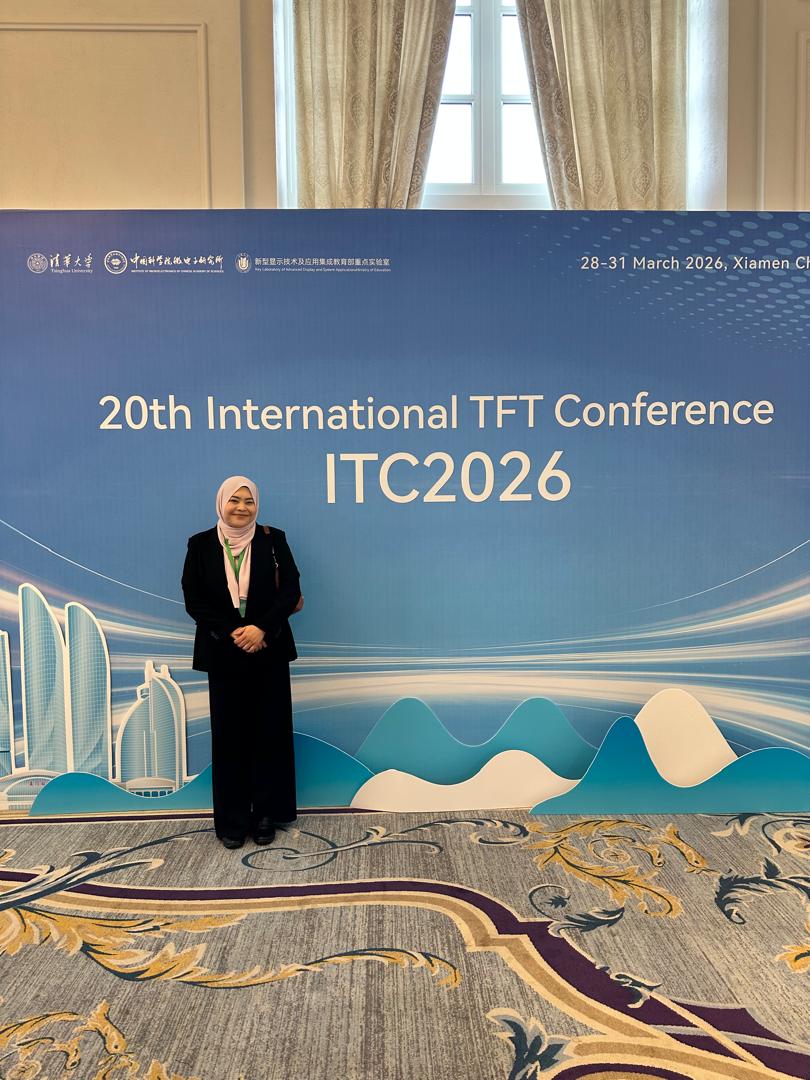
Standing at the podium in Xiamen
By Dr Noorhayati Idros
Standing at the podium of the 20th International Thin-Film Transistor Conference (ITC 2026) in Xiamen, I remember taking a brief moment to look at the audience before I began. Many of the researchers in the room were people whose work I had been reading and learning from over the years, so there was a quiet sense of awareness of where I was, and how I had arrived there.
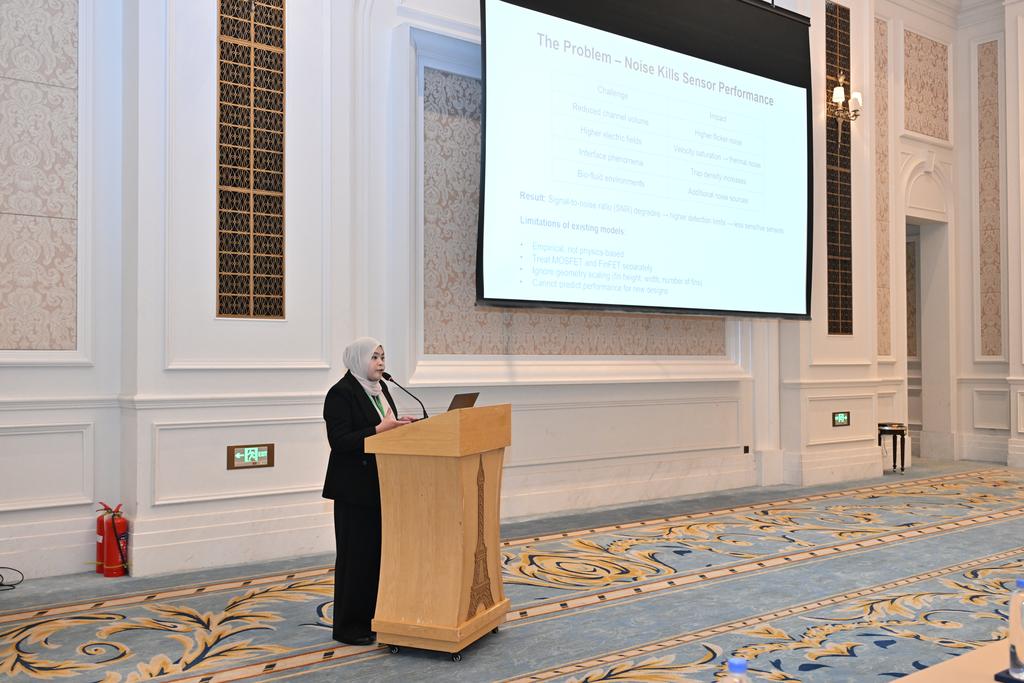
My presentation that day focused on noise in nanotransistor sensors, which is not the most straightforward topic to explain outside of a technical setting. In simple terms, every electronic sensor experiences small random fluctuations, often described as “static”, which can interfere with the signal we are trying to detect. When the signal itself is very small, such as in medical diagnostics or environmental monitoring, this noise becomes a limiting factor in how well the sensor can perform.
What I shared in Xiamen was a way of bringing together different types of noise into a single framework, so that they can be understood and analysed more systematically. This allows us to estimate the limits of detection more clearly, and to think more carefully about how sensors can be designed to operate under optimal conditions. It is still ongoing work, but it is a step towards making these devices more reliable and more useful in practice.
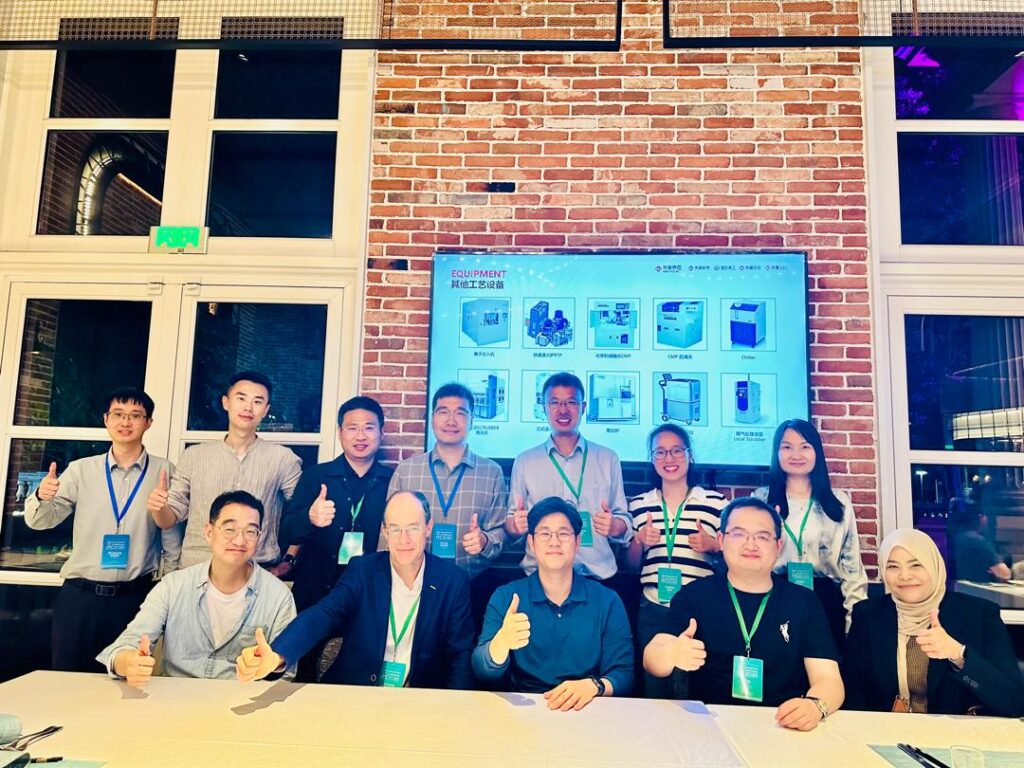
As I went through the presentation, answering a few questions and speaking to several researchers afterwards, I found myself gradually becoming more at ease. The conversations were technical, but also open and collegial. At one point, a professor from my time at the University of Cambridge remarked that the work had brought some structure to what is often seen as a complex and fragmented problem. It was a simple comment, but one that stayed with me.
Moments like these tend to accumulate quietly. They do not necessarily feel significant at the time, but they shape how we see ourselves in relation to the field. By the end of the session, I realised that I no longer felt out of place in that setting. It was not a sudden shift, but more of a gradual recognition that the work we are doing, even from where we are, has a place in the broader conversation.
My interest in this area of research goes back to my doctoral work, where I was developing optical-based biochemical sensors and learning how to detect substances that are not visible to the naked eye. Later, during my time at the Cavendish Laboratory, I had the opportunity to be involved in a project on water quality monitoring in parts of Peru. In some of these locations, access to laboratory facilities was limited, so the work required approaches that could function reliably in the field.
One aspect that left a lasting impression on me was the use of freshwater shrimps as bioindicators. Their condition reflected changes in the surrounding environment, and when combined with sensor data, provided a more complete picture of water quality. It was a reminder that engineering solutions do not exist in isolation, and that sometimes the most effective approaches are those that take into account both technology and the local context in which it is applied.
In many ways, the work on noise modelling connects back to these earlier experiences. While it is more theoretical in nature, it addresses a practical limitation that affects how sensitive and dependable sensors can be. Improvements at this level may seem incremental, but they have implications for how early diseases can be detected, or how accurately environmental conditions can be monitored.
What stayed with me most from Xiamen, however, was not only the presentation itself, but the experience of being part of that environment. Coming from Malaysia, it is easy to feel that much of the leading work in areas like microelectronics takes place elsewhere. But presenting work developed in Kuala Lumpur, and engaging in discussions with researchers from different parts of the world, offered a slightly different perspective.
We may not always have access to the same level of resources as larger research centres, but there is still meaningful work being done, and there are opportunities to contribute in our own ways. Being present, sharing our findings, and taking part in these discussions are part of that process.
As I left the conference hall at the end of the session, I found myself reflecting not so much on the presentation itself, but on what it represented in a broader sense. There is still much to learn, and much to improve, but for that moment, standing at the podium in Xiamen felt like a small step forward in a longer journey.
The author is a Senior Lecturer at the Department of Electrical Engineering, Faculty of Engineering, Universiti Malaya, and was an invited speaker at the 20th International TFT Conference (ITC 2026) in Xiamen, China recently. She may be reached at noorhayati@um.edu.my