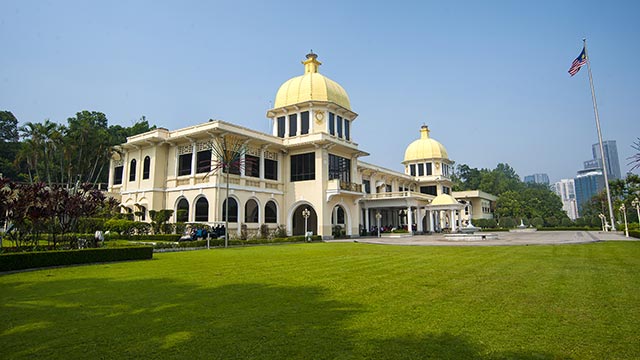
A palace where our memories live
By Sr Dr. Zuraini Md Ali and Nurul Alia Ahamad
Each year on 18 May, the world observes International Museum Day: a moment to pause and recognise museums not simply as repositories of artefacts, but as living institutions where memory, identity, and culture are continuously shaped and shared. They are spaces where the past does not sit quietly behind glass but speaks; sometimes softly, sometimes powerfully, into the present.
This year, in the heart of Kuala Lumpur, one such place prepares to speak again.
The Royal Museum, located along Jalan Istana, is set to reopen its doors in the coming months, offering visitors a renewed opportunity to encounter a site where the nation’s history unfolds not in abstraction, but through space, form, and lived experience. For many, it is a familiar landmark. Yet beyond its gates lies something far more profound: a palace that has witnessed the evolving story of Malaysia itself.
Once known as Istana Negara, this building is far more than an architectural artefact preserved in time. It is a witness; silent yet enduring; to moments that have shaped the nation. Long before it assumed its role as the official royal residence, the building had already undergone a series of transformations, reflecting the layered history of Kuala Lumpur as it grew from a colonial settlement into a modern capital city.
From 1957 until 2011, the palace stood at the centre of Malaysia’s governance and ceremonial life. Thirteen Yang di-Pertuan Agong and their consorts were associated with this residence, each representing continuity within the nation’s unique rotational monarchy system. Though one ruler did not formally reside within its walls due to his untimely passing before installation, the palace nonetheless remained a powerful symbol of unity, sovereignty, and national identity.
Within its halls, the nation’s most significant ceremonies unfolded. Investitures were conducted with dignity and precision. Foreign dignitaries were received with grace and protocol. National honours were conferred in recognition of service and contribution. Yet beyond these moments of grandeur, the palace also bore witness to quieter, more intimate rhythms of leadership; moments of reflection, responsibility, and duty that rarely enter public discourse, yet define the essence of governance.
The palace’s presence extended beyond its physical boundaries. In the 1980s, it became part of Malaysia’s everyday visual culture when it was featured on the reverse side of the five-ringgit banknote in the second series of Malaysian currency. In doing so, the image of the palace travelled into the hands of ordinary citizens, embedding itself into the daily lives and subconscious memory of the nation.
Recognising its historical and cultural significance, the building was gazetted as a National Heritage site in 2007 under the National Heritage Act 2005 (Act 645). This designation was not merely symbolic. It affirmed the building’s role as a custodian of national memory; a place whose value lies not only in its architectural form, but in the stories it continues to hold.
A significant transition took place in 2011 with the completion of the new Istana Negara complex at Jalan Tuanku Abdul Halim. As the royal household relocated, the former palace entered a new phase of its life. Rather than being left to fade into obsolescence, it was carefully reimagined; its purpose redefined for public engagement.
On 1 February 2013, the building was opened to the public as the Royal Museum. For the first time, spaces that were once private became accessible. Rooms that had been reserved for royalty were opened to the public, allowing visitors to move through the palace not as distant observers, but as participants in a shared historical narrative.
However, like all heritage structures, the passage of time necessitates care. On 7 March 2022 until June 2026, the museum is temporarily closed to facilitate conservation and preservation works. This effort, undertaken through a collaboration between Jabatan Muzium Malaysia, Kementerian Perpaduan Negara, and Jabatan Kerja Raya Wilayah Persekutuan Kuala Lumpur, with consultants led by GRA Architects Sdn Bhd and the main contractor Kamal Engineering Sdn. Bhd. reflects a commitment to safeguarding the building’s integrity for future generations.
Today, as it prepares to reopen, the Royal Museum stands not simply as a preserved monument, but as a living storyteller.
In an age defined by rapid development and constant change, such places offer something increasingly rare: a sense of stillness. They remind us that history is not something distant or detached. It is embedded within the spaces we inherit, carried forward in ways both visible and unseen.
The reopening of the Royal Museum is therefore more than an event. It is an invitation. An invitation to walk through history; not as a series of dates and facts, but as an experience. An invitation to reflect on the journey of a nation, and on the values that have shaped its identity. And perhaps most importantly, an invitation to recognise that heritage is not static. It lives, evolves, and continues to inform who we are.
As the Malay proverb reminds us, “Tak lapuk dek hujan, tak lekang dek panas”; that which is rooted in heritage endures, weathering time and change without losing its essence. In this palace, such endurance is not merely preserved within walls of stone and plaster. It is felt in the air, in the silence between rooms, in the stories that linger long after one has left.
Here, memory does not fade. It lives.
Sr Dr. Zuraini Md Ali is an Associate Professor at the Building Surveying Department, Faculty of Built Environment, Universiti Malaya, and Nurul Alia Ahamad is a Senior Lecturer at the School of Architecture, Building and Design, Taylor’s University.