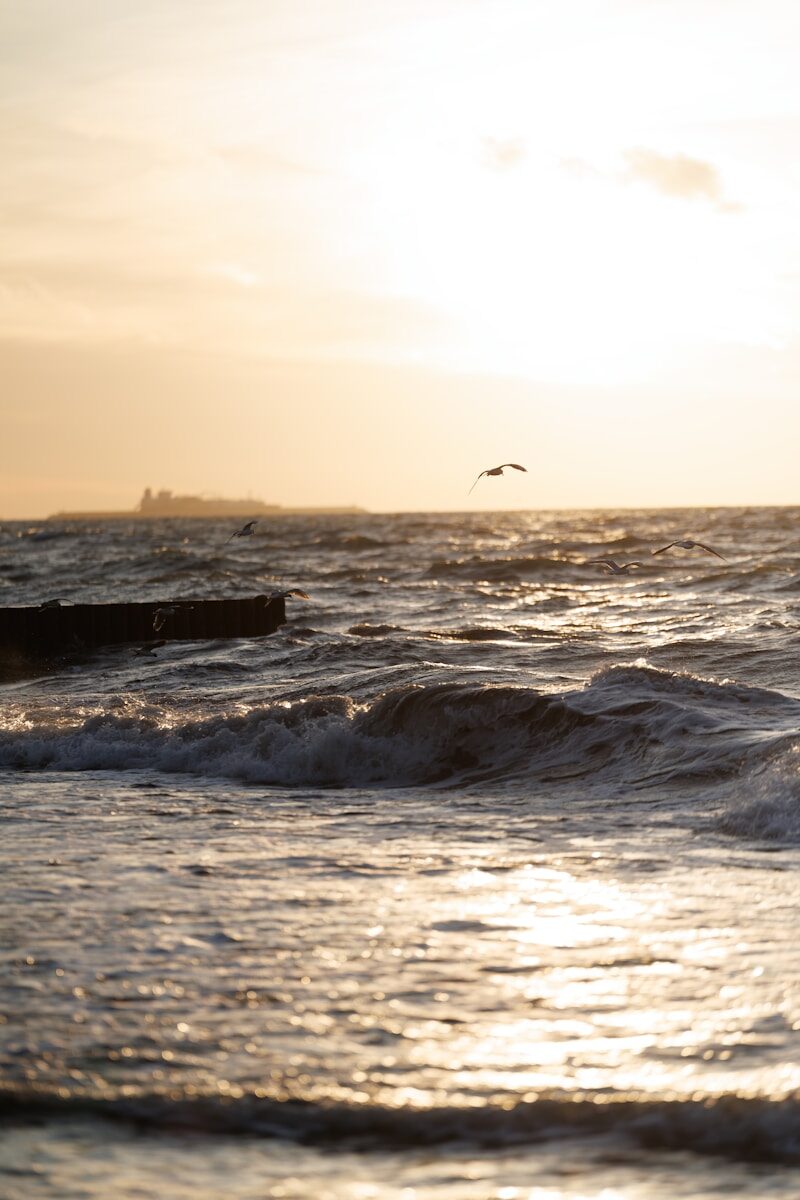
Harnessing the next frontier, the ocean
By Professor Dato Dr Ahmad Ibrahim
The ocean has always been largely taken for granted. But as we face a planetary ceiling on land—every arable acre spoken for, every forest shrinking, every city sprawling—we are finally turning our gaze seaward. The ocean is, indeed, the next frontier. Yet we arrive at this frontier as trespassers rather than stewards. The ocean is not healthy; it is overheated, acidifying, and choking with plastic. The question before us is not whether we should tap its potential, but how we can do so without committing ecological suicide.
For centuries, we have treated the ocean as a hunting ground. We have chased fish stocks to the edge of collapse. If we are to feed a growing population from the sea, we must transition to becoming farmers. The future of oceanic food lies in regenerative aquaculture. We must invest heavily in farming shellfish, kelp, and bivalves—species that do not require feed inputs but actually clean the water and build ecosystems. Imagine vast, rotating offshore farms where seaweed and mussels act as the kidneys of the ocean, absorbing excess nutrients. This means moving salmon pens and other finfish operations onshore into closed-loop systems, severing the link between dense fish populations and the fragile wild environment. The technology exists; what is needed is the political will to embrace the transition.
The ocean offers immense power. The wind blows harder and more consistently at sea, the tides are mechanically predictable, and the sun beats down on vast, empty expanses. But our first attempts to harness this—the sprawling offshore wind farms and nascent tidal arrays—must be built with a humility we have lacked on land. The solution is to design with nature, not against it. We should prioritize floating platforms that minimize seabed disruption and, crucially, integrate them with the food systems mentioned above. Why have a wind farm that just generates power when it can also serve as the infrastructure for kelp aquaculture? Why build a tidal barrier that just spins turbines when it can also be designed as an artificial reef?
This requires a regulatory revolution. Currently, we license energy, fishing, and shipping in separate silos. We need a unified maritime spatial planning system that maps the ocean not as a void, but as a three-dimensional volume of life. We must decide where we leave wilderness, where we allow multi-use development, and where we restore. This is where the temptation is greatest, and the danger most acute. The seabed is littered with nodules of cobalt, nickel, and rare earth metals—the lifeblood of the green transition. Mining companies are ready to lower the machinery. We must resist. Deep-sea mining threatens to unravel ecosystems we do not yet understand, releasing sediment plumes that could smother life for centuries. We do not need to tear apart the abyssal plains to fuel our future. We need a circular economy first.
Before we look down, we must look around. The world discards millions of tons of electronic waste annually—a veritable urban mine of the very minerals we seek. The first step to tapping the ocean’s resource potential is to implement a global, binding agreement to recycle everything on land before we touch the seabed. The ocean floor must remain a sanctuary, not a sacrifice zone. A moratorium on deep-sea mining, with a permanent ban unless and until science proves it can be done without harm, is the only responsible course.
None of these opportunities are possible in a dead ocean. A dead ocean stores no carbon, grows no fish, and generates no oxygen. Our first “step” is not to build or extract, but to heal. We must treat plastic pollution with the urgency of a climate crisis, halting the flow of waste at its source. We must massively expand Marine Protected Areas, aiming not for 10% or 20%, but for 30% of the ocean as fully protected wilderness by 2030. These are not just parks; they are the engine rooms that restock the seas and build resilience against warming.
The ocean is not a grocery store, a gas station, or a mine. It is a living system. If we approach it with the same extractive mindset that has scorched the land, we will inherit a dead sea and a stalled economy. But if we approach it as gardeners, as partners, and as students—if we realize that the health of the ocean is the health of the economy—then the blue frontier offers not just resources, but a model for a new kind of relationship with our planet. The choice is simple: We can be the generation that killed the ocean, or the one that learned to live with it.
The author is affiliated with the Tan Sri Omar Centre for STI Policy Studies at UCSI University and is an Adjunct Professor at the Ungku Aziz Centre for Development Studies, Universiti Malaya. He can be reached at ahmadibrahim@ucsiuniversity.edu.my.